Click here to view with images.
To ensure delivery to your inbox, please add charles.strouss@cbre.com to your address book.
 
U.S. MARKETFLASH

Steel & Lumber Prices Raise Costs but Don’t Dent Robust Construction Pipeline 

MAY 24, 2021
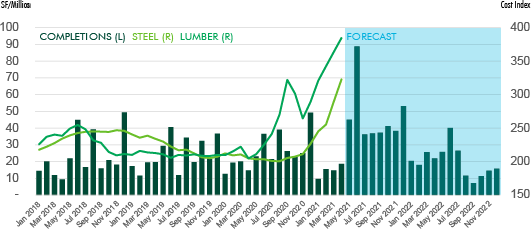
High demand and limited supply have led to dramatic increases in domestic steel and lumber prices this year, significantly increasing the cost of commercial real estate development. By early May, both steel and lumber prices had more than tripled since late last year, according to SteelBenchmarker and TradingEconomics. However, since peaking at $1,686 per thousand board feet on May 7, lumber prices have dropped by 23% to $1,306 on May 19—still up by 260% from late last year.
  
The pricing surge is partly due to limited supply after many steel and lumber mills were temporarily closed during the height of the COVID-19 pandemic last year. As restrictions eased and commercial real estate development began to resume, producers were unable to keep up with skyrocketing steel and lumber demand.
  
Rising costs are creating sticker shock for developers, causing some to cancel or postpone projects. Others are increasing their pre-pandemic construction budgets by as much as 20%, anecdotal evidence suggests.
  
Despite some cancellations, 2021 will still see a boom in new commercial real estate development. Dodge Data & Analytics reports that projects costing more than $50 million each will increase by at least 40% year-over-year for total completions of 430 million sq. ft. Multifamily projects account for around 45% or 194 million sq. ft. of that total, followed by warehouse projects at 36% or 158 million sq. ft. Office projects account for 17% and retail projects just under 2%.
Figure 1: Construction Materials Cost Index with CRE Completions
CRE Projects $50 Million and Higher, includes office, industrial, retail, and multifamily. 
Steel and Lumber Index: 1982 = 100. 
Source: St. Louis FRED, CBRE Research, Q2 2021.


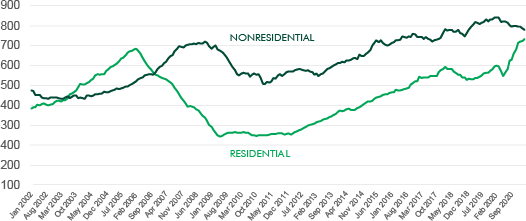
Residential development spending today is nearly the same (95%) as that of commercial real estate development, after hitting a low of just 36% in 2009. With thriving single-family home markets across the U.S. seeing even more new development and permit authorizations in 2021 at a 10-year high, this trend shows no sign of reversing.
Figure 2: Total Construction Spending, Residential vs. Nonresidential ($ Billions)
Residential spending includes both single-family and multifamily construction.
Source: St. Louis FRED, CBRE Research, Q2 2021.


CBRE Capital Markets | Investment Properties
CHARLES STROUSS
Executive Vice President  
Lic. 01372483
+1 650 773 5881
charles.strouss@cbre.com
JONATHAN ZIEGLER
Analyst
Lic. 02072075
+1 650 388 6044
​jonathan.ziegler@cbre.com
YVONNE HSIUNG
Transaction & Project Manager
Lic. 02045130
+1 650 868 1526
yvonne.hsiung@cbre.com
CBRE Research
Unsubscribe

You may also unsubscribe by calling toll-free +1 877 CBRE 330 (+1 877 227 3330).

Please consider the environment before printing this email.

CBRE respects your privacy. A copy of our Privacy Policy is available online. For California Residents, our California Privacy Notice is available here. If you have questions or concerns about our compliance with this policy, please email PrivacyAdministrator@cbre.com or write to Attn: Marketing Department, Privacy Administrator, CBRE, 200 Park Ave. 19-22 Floors, New York, NY 10166.

Address: 225 W. Santa Clara Street, 12th Floor Suite 700, San Jose CA 95113

© 2026 CBRE Statistics contained herein may represent a different data set than that used to generate National Vacancy and Availability Index statistics published by CBRE Corporate Communications or CBRE's research and econometric forecasting unit, CBRE Econometric Advisors. Information herein has been obtained from sources believed reliable. While we do not doubt its accuracy, we have not verified it and make no guarantee, warranty or representation about it. It is your responsibility to independently confirm its accuracy and completeness. Any projections, opinions, assumptions or estimates used are for example only and do not represent the current or future performance of the market. This information is designed exclusively for use by CBRE clients, and cannot be reproduced without prior written permission of CBRE.

CBRE and the CBRE logo are service marks of CBRE, Inc. All other marks displayed on this document are the property of their respective owners, and the use of such logos does not imply any affiliation with or endorsement of CBRE.

Photos herein are the property of their respective owners. Use of these images without the express written consent of the owner is prohibited.

 
All of CBRE's COVID-19 related materials have been developed with information from the World Health Organization, the Centers for Disease Control & Prevention (and similar global organizations), public health experts, industrial hygienists, and global subject matter experts across CBRE and our strategic suppliers. Our materials may not be suitable for application to all facilities or situations.

Ultimately, occupiers and landlords must make and implement their own reopening decisions for their individual stakeholders and facilities. CBRE's guidance is intended to help facilitate those discussions and expedite the implementation of those decisions once made by the client. We make no representations or warranties regarding the accuracy or completeness of these materials. CBRE cannot ensure safety and disclaims all liability arising from use of these materials.